Asset Allocation Strategies for Beginners
What Asset Allocation Actually Means
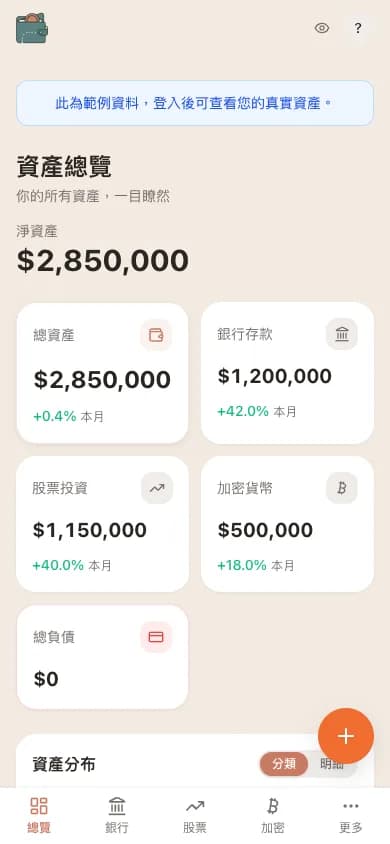 WalletMap mobile dashboard with asset allocation donut chart
Asset allocation is just the mix — how much of your money sits in stocks vs. bonds vs. cash vs. real estate vs. crypto, and so on. You pick that mix based on your goals, how much volatility you can stomach, and when you'll actually need the money.
Honestly, it's the most consequential decision you make as an investor. Decades of research keep pointing at the same thing: over the long run, the mix matters more than the picks. Choosing 70/30 stocks-to-bonds shapes your outcome more than which two stocks you own inside that 70%.
Why It Matters

Different assets react differently to the same news. When stocks tank in a recession, bonds usually hold steady or rise. When inflation spikes, real assets like real estate and commodities tend to do better than cash. Spreading your money around means no single event wrecks the whole portfolio.
This isn't about eliminating risk — a bad market still hurts. But a well-allocated portfolio loses less than a concentrated one, and it tends to recover faster because not everything is dropping at once.
There's also the life-stage angle. A 25-year-old saving for a retirement that's 40 years out has very different needs than a 60-year-old who plans to stop working in five. The young investor can afford volatility because they have decades to ride it out. The older one needs to protect what they've already built. A clear allocation gives you a framework for adjusting as your situation changes.
The hidden bonus: when markets crash and panic kicks in, having an allocation means you have rules. The strategy tells you what to do — rebalance, maybe buy more stocks while they're cheap — instead of leaving you to make decisions on adrenaline.
Common Allocation Strategies
The 60/40 Portfolio
The classic: 60% stocks, 40% bonds. It's been the standard moderate-risk recipe for decades — usually 60% in a diversified stock index fund (domestic and international) and 40% in a diversified bond fund (government and corporate).
It's simple, historically delivers solid returns with manageable volatility, and the bonds give you both income and a cushion when stocks drop. The catch: in low interest rate environments the bond side can drag returns down, it doesn't account for your specific situation, and for younger investors with long horizons it can be too conservative.
Age-Based Allocation
A quick rule of thumb: subtract your age from 110 (or 120, depending on who you ask). That's your stock percentage; the rest goes to bonds and cash.
A 30-year-old gets 80% stocks, 20% bonds and cash. A 55-year-old gets 55/45. Easy to remember, gets more conservative automatically as you age, and works as a reasonable starting point for most people.
The downside is obvious — it's crude. Two 30-year-olds with wildly different incomes, expenses, and temperaments end up with the same recommendation. Age is one input, not the only one.
The Three-Fund Portfolio
Popular among index fund fans because you get broad diversification with three funds:
- A domestic stock index fund (e.g., total US market)
- An international stock index fund (e.g., total international market)
- A bond index fund (e.g., total bond market)
A common starting mix for a younger investor is 50% domestic stocks, 30% international, 20% bonds.
The appeal is hard to beat: extremely low fees, exposure to thousands of securities, and only three positions to track. It doesn't include alternatives like real estate, commodities, or crypto. It also requires real discipline during downturns, and the international slice is one of those eternal arguments — some say more, some say less.
Core-Satellite
This one mixes a passive core with smaller "satellite" bets in specific sectors or asset classes.
The core (70-80% of the portfolio) sits in broad stock and bond index funds — low-cost and stable. The satellites (the remaining 20-30%) are where you can hold individual stocks you believe in, sector funds (tech, healthcare, clean energy), or alternatives like real estate, crypto, or commodities.
You get most of the benefits of indexing while leaving room for conviction bets, and bad satellite picks can't sink the whole ship. It also scratches the itch for investors who want some active involvement. The downside: more complexity, satellites can sneak in concentration risk, and you have more decisions to make.
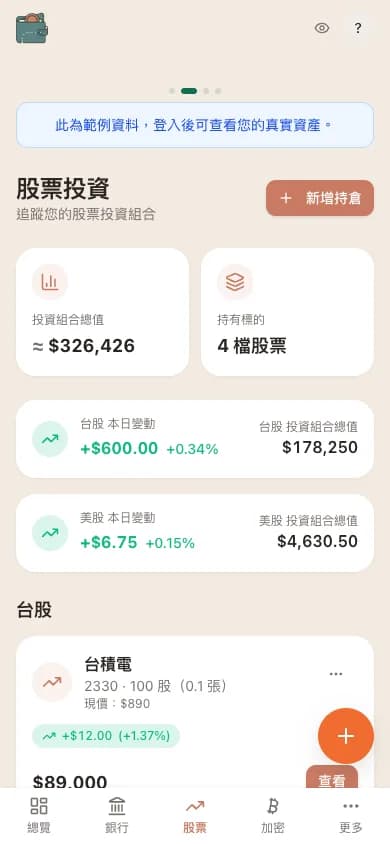 How stock holdings appear in WalletMap mobile
Diversifying Across Asset Types
Real diversification means owning genuinely different things, not just a bunch of different stocks. The main categories worth knowing:
Equities (stocks) are ownership in companies. Highest long-term returns historically, but also the most volatile in the short term. Worth diversifying across domestic and international, large-cap and small-cap, growth and value, developed and emerging.
Fixed income (bonds) are loans to governments or corporations that pay interest. Lower returns than stocks but more stable. Government bonds for safety, corporate bonds for higher yield, short-term for stability, long-term for income.
Cash and equivalents — savings accounts, money market funds, short-term CDs. Safest, lowest returns. Keep enough for an emergency fund (three to six months of expenses), near-term planned expenses, and dry powder for opportunistic buying when markets dip.
Real estate is physical property or REITs. You get rent income and potential appreciation, decent inflation protection (rents and prices tend to rise with inflation), and low correlation with stocks and bonds.
Crypto — Bitcoin, Ethereum, and similar. Highly volatile, potentially high returns. If you include it, keep the allocation small (typically 1-10% depending on tolerance), accept that it can drop 50%+ in a hurry, treat it as long-term holding rather than a trading position, and track it alongside everything else so your real allocation stays honest.
Watching Your Allocation with Charts
Setting an allocation is the easy part. The hard part is that markets keep moving and your real allocation drifts.
Quick example: stocks have a great year and rise 25% while bonds return 3%. Your 60/40 portfolio is now closer to 67/33. You're carrying more equity risk than you signed up for. Conversely, if stocks drop hard, you might end up at 50/50 — more conservative than planned, and likely missing out on the recovery.
Charts make this much easier to spot. A simple pie chart showing current vs. target allocation tells you instantly where you're overweight or underweight.
WalletMap shows these automatically. Open the dashboard and you can see:
- Current allocation by asset class (stocks, bonds, cash, crypto, real estate)
- Allocation by currency for multi-currency portfolios
- How your allocation has shifted over time
- Comparison against your target allocation
It's a lot easier to spot a rebalance trigger from a chart than from staring at spreadsheet rows.
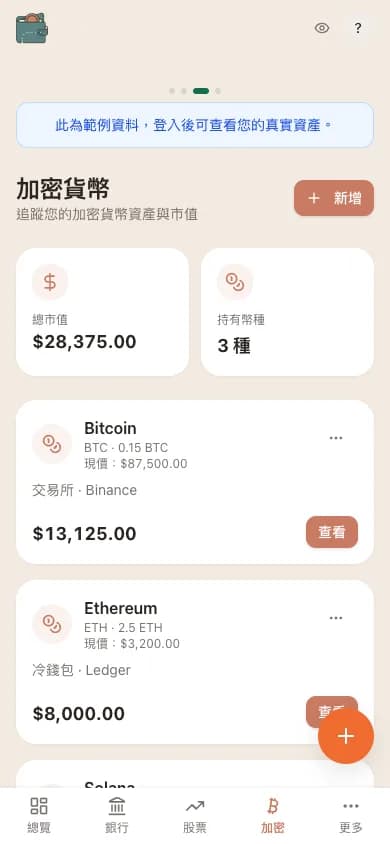 How crypto holdings appear in WalletMap mobile
Rebalancing Basics
Rebalancing is the act of pulling your portfolio back to its target allocation. It means selling what's done well and buying what's done poorly — the opposite of what your gut wants.
There are two common ways to decide when. Calendar-based means you rebalance on a fixed schedule (quarterly, twice a year, annually). It's simple and removes the temptation to time the market. Threshold-based means you rebalance when an asset class drifts more than some percentage (often 5%) from its target. More responsive but you have to monitor it.
For most individual investors, once a year is plenty. Doing it more often racks up trading costs and taxes without meaningfully improving returns.
The actual mechanics: check the current allocation against your targets, see what's overweight and underweight, then either sell from the overweight side to buy the underweight side — or just direct new contributions to the underweight side instead. The second approach is great because it avoids selling and the taxes that come with it, especially during the years when you're regularly adding money to the portfolio.
A note on taxes: selling appreciated assets triggers capital gains. To soften the hit, rebalance inside tax-advantaged accounts when you can, use new contributions to do the work, and consider tax-loss harvesting (selling losers to offset gains elsewhere). If you must sell in a taxable account, lean toward long-term holdings, which usually get a friendlier rate.
Getting Started
If you're new to all this, here's a practical path:
- Figure out your time horizon. When do you actually need this money? Retirement in 30 years? A house in five?
- Be honest about risk tolerance. If your portfolio dropped 30% in a month, would you panic-sell or buy more?
- Pick a starting allocation. The age-based rule or 60/40 are both fine launching points. Adjust based on your situation.
- Implement with low-cost index funds. Fees compound against you, so keep them low.
- Track everything in one place. A tool like WalletMap helps you see your allocation across all accounts.
- Rebalance once a year. Check it, adjust if it's drifted significantly, move on.
Look — the best allocation isn't the most clever one, it's the one you can actually stick with through good years and bad. It doesn't need to be perfect. It needs to be consistent. Start simple, track it clearly, and refine over time as you learn more about your own risk tolerance and goals.
Personally I just dump every position into WalletMap and let the donut chart do the work — when the mix drifts, it's obvious at a glance instead of something I have to recalculate. Data still lives in my own Google Sheet, which I find easier to trust than another aggregator.