Track Stocks and Crypto in One Dashboard: A Complete Guide
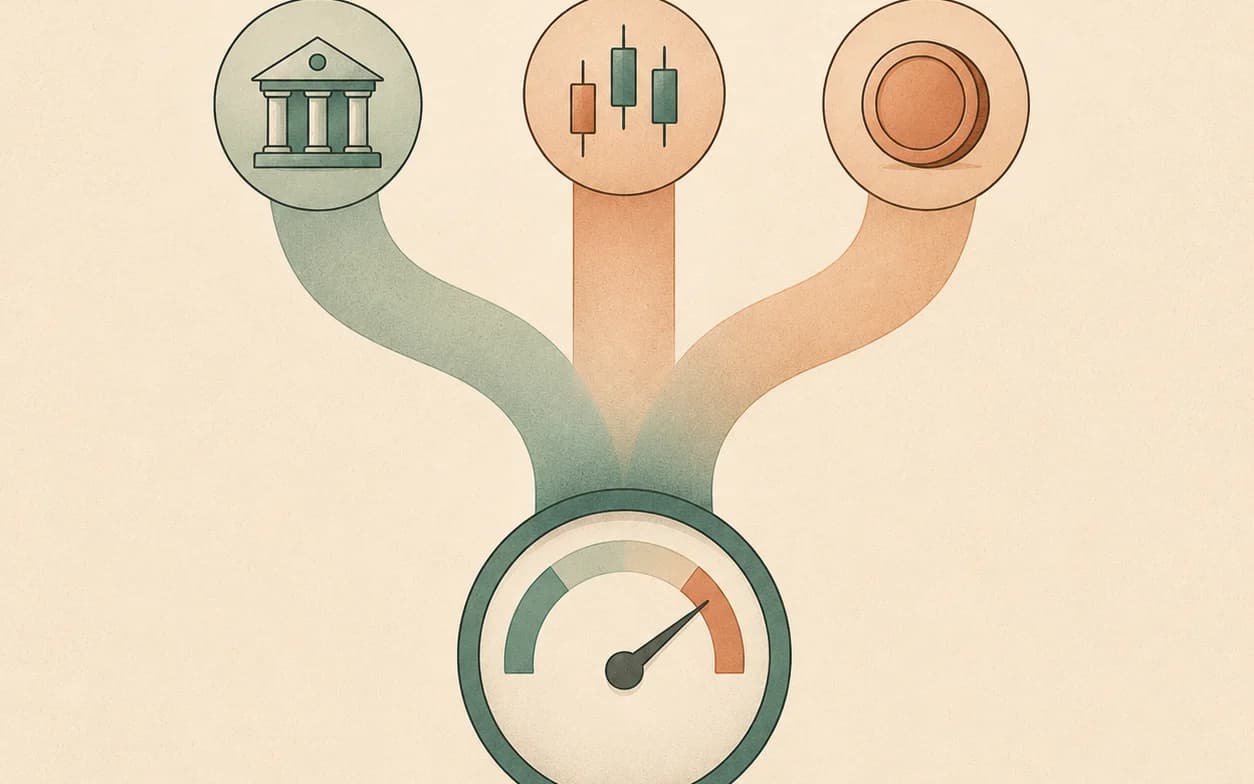 You've probably been here. Salary lands in one bank, emergency fund sits in a high-yield savings account at another, local stocks live on one broker, US equities on another, and crypto is sprinkled across three exchanges. Every time you want to answer "what am I actually worth?" — five logins, copy-paste, mental math.
It's not just annoying. When your portfolio spans countries, currencies, and asset classes, fragmented data means you're making decisions half-blind.
What fragmented investing actually costs you
A pretty typical globally-diversified setup these days: a checking account for emergencies, local stocks (ETFs and individual names) on a domestic broker, US equities on a US broker, BTC and ETH on crypto exchanges, and maybe some foreign currency deposits or international positions on the side.
When everything lives in a different system, a few problems show up fast.
No unified view. You open five to ten sites, log in, jot down numbers. By the time you're done with the math, prices have moved.
Currencies blur together. Local stocks in your home currency, US equities in USD, crypto sometimes in USDT. FX moves quietly behind the scenes — your real net worth shifts daily, and you can barely see it.
Risk allocation becomes guesswork. You meant to be 40/40/20 across local stocks, US equities, and crypto. But one rallied, another tanked, and now you're 30/50/20 — and you won't notice unless you check by hand.
Rebalancing is invisible. Did one position get too big? Are you underweight somewhere? Without a single dashboard, every one of those questions costs real effort.
Four approaches, honestly compared

No solution is perfect. Here's the real tradeoff for each.
Option A: pure manual Google Sheets
The full DIY approach. Build your own spreadsheet, log into each platform on a schedule, paste in numbers, let formulas do the totals.
You get total control — the data is yours, the layout is yours, no third parties involved, and it's free. The catch is the upkeep. Updates eat time, manually entered prices go stale fast, formulas alone won't give you decent visualizations, and you're handling currency conversion by hand.
If your portfolio is simple (a few ETFs plus a savings account), manual Sheets is genuinely fine. The moment things get complicated, the maintenance load piles up.
Option B: portfolio tracking platforms (Morningstar, Yahoo Finance Portfolio, etc.)
Morningstar's portfolio tools now sit behind a paid subscription (Morningstar Investor, roughly $249/year). Yahoo Finance's portfolio tracker is free to use — the paid tier just adds deeper analytics. Both require you to enter and maintain your holdings by hand; neither auto-links to your bank accounts.
The upside is real: professional analysis tools, charts, performance metrics, risk views, all in one place, and some of them have great historical data. The catch: crypto coverage tends to be weaker than stocks, and a lot of the deeper analytics sit behind a paywall.
Best fit if your portfolio is complex and you want professional-grade analysis tools — just know you're still keying in your positions yourself.
Option C: DIY API automation
What developers reach for. Write scripts that hit broker APIs, crypto exchange APIs, and FX APIs, and pipe the data into your own database or spreadsheet.
Total customization, data stays on your machines, full automation possible. The cost is that you need to write code, APIs change all the time and break your scripts, and you're now responsible for storing API keys safely. Fun if you're an engineer. Not realistic for most investors.
Option D: spreadsheet + automated quotes
The middle ground between pure manual tracking and writing your own API integration is using Google Sheets as the source of truth, then connecting quote sources that can refresh automatically. For supported securities, Google's GOOGLEFINANCE documentation explains the available data; for crypto, the CoinGecko API documentation is one possible source. The right setup depends on the markets you need, refresh frequency, technical comfort, and where the data is stored.
In practice:
-
You make a Google Sheet listing everything:
- Cash: $100,000
- TSMC (2330): 50 shares
- Taiwan 50 (0050): 20 shares
- Apple (AAPL): 10 shares
- Bitcoin: 0.5 BTC
- Ethereum: 5 ETH
-
Let the quote sources read only the fields they need, and check the permissions carefully.
-
Pull stock, crypto, and FX data separately, then use spreadsheet formulas to calculate total assets, allocation, and changes.
-
Review the refresh status, invalid tickers, and any holding changes on a regular schedule.
The upside is keeping the flexibility of a spreadsheet while reducing repetitive price lookups. The tradeoffs are source delays or rate limits, plus the need to review holdings and errors yourself. It fits people who want fewer manual updates and are willing to understand how their data sources and settings work.
Comparison Summary
| Manual Sheets | Portfolio Trackers | DIY Code | Spreadsheet + Automated Quotes | |
|---|---|---|---|---|
| Automation | Low | Medium (prices auto, holdings manual) | High | Medium |
| Technical barrier | Low | Low | High | Low |
| Data location | Your device/cloud | Platform servers | Your systems | Depends on source and setup |
| Crypto support | Manual price lookup | Partial | Fully custom | Depends on the quote source |
| Multi-currency | Manual conversion | Most support it | Fully custom | Depends on formulas and sources |
| Cost | Free | Partially paid | Free (but time-intensive) | Depends on sources or tools |
Quick read: want a ready-made interface → portfolio tracker. Total customization → write your own. Balance between convenience and data control → spreadsheet plus automated quotes. Simple portfolio, no external sources → manual Sheets is fine.
A concrete example
Say this is your portfolio:
| Asset | Holding | Current Value |
|---|---|---|
| Cash (TWD) | NT$100,000 | NT$100,000 |
| TSMC (2330) | 50 shares | NT$240,000 |
| Taiwan 50 (0050) | 20 shares | NT$48,000 |
| Apple (AAPL) | 10 shares @ $180 | NT$58,500 |
| Bitcoin (BTC) | 0.5 | NT$636,000 |
| Ethereum (ETH) | 5 | NT$68,400 |
| TOTAL | NT$1,150,900 |
Doing this manually means logging into your bank, your local broker, your US broker, your crypto exchange, and an FX site, then converting and summing everything. Realistically that's 15–20 minutes.
If you walk through it with one spreadsheet + GOOGLEFINANCE + CoinGecko, the flow is:
- List cash, stocks, and crypto holdings in one sheet.
- Use
GOOGLEFINANCEfor supported markets and record the currency in a separate column. - Query crypto prices through the CoinGecko API, then enter or import the returned values into the sheet.
- Use FX and multiplication formulas to convert each position, then total assets and allocation.
Update holdings when you trade, and recheck the numbers when a quote source is delayed or unavailable.
Getting started
- Create a Google Sheet with all your holdings (cash, stocks, crypto)
- Set up
GOOGLEFINANCEfor stocks and choose CoinGecko API or another verifiable source for crypto - Add currency, FX, quantity, and market-price formulas to calculate each position
- Organize total assets, allocation, and monthly trends in the same sheet
- Set a regular review time to catch stale quotes, FX changes, and missing holding updates
When your investments span countries, currencies, and asset classes, a single tool saves real time and gives you actual visibility into your allocation.
Each approach has its own strengths — portfolio trackers give you a ready-made interface, manual Sheets is the most flexible, and a spreadsheet plus automated quotes sits in the middle. Pick whichever matches how you actually work.
Whatever you choose, the only thing that really matters is starting. Once you can see the whole picture, every other investment decision gets easier.
If "don't want to hand over account credentials, but also don't want to keep pasting prices" describes you, a spreadsheet plus automated quotes is a workable middle path — as long as you accept source limitations and keep a regular review habit.
Further reading
- How to Track Your Investments (guide)
- GOOGLEFINANCE Stock Price Tracking
- How to Track Your Crypto Portfolio